Within the intensely competitive world of modern pro-level drifting, victory is no longer purely a function of brute torque or driver courage. Conversely, it has become a intricate engineering challenge that requires a meticulous marriage of picking a proven chassis, outfitting it with the correct performance parts, and, most essentially, understanding its real-time performance on the course through advanced vehicle dynamics analysis tools. This definitive manual will serve as your blueprint from the very first idea of a competition vehicle all the way to the final telemetry-optimized tweaks that transform a powerful car into a predictable champion. We will examine in detail the art and science of vehicle alignment optimization, illustrating how a state-of-the-art drift tuning app like precise measurement hardware eliminates guesswork and provides unparalleled insight into your vehicle's true performance.
The foundation of any great drift car is, without question, the chassis itself. Certain platforms have achieved iconic reputation within the worldwide drifting community due to their inherent balance, robust design, and the enormous availability of specialist parts available. Choosing the optimal starting point is the first and most significant choice a enthusiast will make. To illustrate, the BMW E36 is widely regarded as one of the finest overall drift platforms of the modern era. Its near-perfect balanced front-to-rear weight, combined with a RWD configuration and robust six-cylinder motors, forms a car that is both forgiving for beginners and highly competitive in the possession of a professional pilot. The successor of this philosophy, the BMW E46, improves on these qualities with a more sophisticated frame, increased track for greater stability, and still a greater degree of turning capability straight from the manufacturer. A different dominant contender in the professional circuit is the C6 generation Corvette.
This muscle-derived performance car brings a distinctive set of benefits to the drifting discipline, featuring a light alloy chassis, a backwards-positioned transaxle that contributes to an ideal weight distribution, and the tremendous torque of a big GM LS engine. This combination renders it an absolute monster on track, designed of starting and maintaining continuous slides with seemingly minimal use of throttle. For drivers looking for exceptional performance per dollar, the 350Z model Nissan stands out as a excellent candidate. It arrives from the manufacturer with a rigid chassis, a decent factory locking differential, and the free-revving VQ35DE powerplant that provides plenty of performance for practicing and advancing in the activity. Its newer version, the Nissan 370Z, offers further advancements in body strength, handling precision, and overall motor power, solidifying its place as a favorite pick among professional drivers. Other legendary vehicles that merit mention encompass the agile unique Mazda FC RX-7, the ubiquitous Nissan S13 240SX, the V8-powered SN95 generation Mustang, the more recent BMW E90, and the compact yet unbelievably playful and forgiving MX-5 Miata. Every single one of these cars offers a distinct array of traits, difficulties, and capabilities, but they all have in common the core elements required to become a capable sliding vehicle.
However, selecting the correct platform is merely the first step. To access the true capability of every of these vehicles, major modifications to the steering system and damping and springing systems are utterly non-negotiable. This is where the realm of specialist aftermarket hardware becomes critical importance. The one most game-changing improvement for a serious drift car is the fitting of a drift-spec steering angle kit. These sophisticated assemblies, for example those engineered by industry leaders like SLR Speed, are designed to dramatically expand the chassis's maximum steering angle. A factory street car is extremely constrained in how far its tires can rotate, a safety trade-off for public road driving. In drifting, however, aggressive countersteering is continuously required to control and maintain a slide. An steering kit replaces the stock steering knuckles, linkages, and potentially A-arms with components that enable the wheels to achieve steering lock in excess of 70 or even 80 degrees, compared to a average factory limit of around 40 to 50 degs.
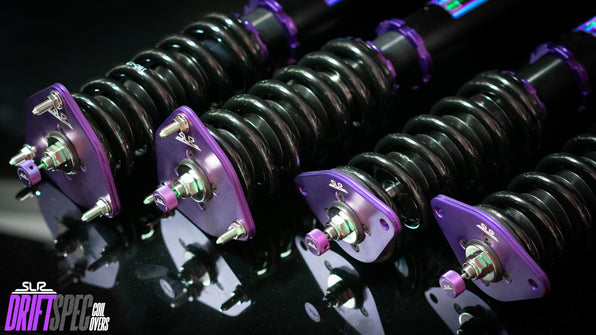
This vastly greater steering angle gives the driver with dramatically greater authority during a angle, enabling it to be much more straightforward to begin a slide, hold it through a sweeping turn, and switch fluidly from one direction to another. The improvement in controllability is nothing short of transformative. Paired with a appropriately specified modification is the equally essential modification to the vehicle's spring and damper setup. Off-the-shelf or including premium sport coilovers are generally not engineered for the particular and harsh demands of competitive oversteer. A purpose-built system of adjustable dampers is of utmost importance. These specific suspension components incorporate custom piston tuning and spring rates that are tuned for the rapid load shifting that is characteristic of sliding. When a driver starts a drift, the car's inertia is transferred rapidly to the front of the corner. Correct competition coilovers control this transfer in a consistent manner, enabling the car to settle rapidly and offering the driver precise response through the wheel and seat. They furthermore allow for exact adjustment of stance, shock absorber rate, and cross-weight, which are all integral elements of optimizing the vehicle's dynamics to a specific circuit or competition technique. Together, a top-tier steering angle kit and a expertly selected set of competition suspension units form the core physical cornerstone upon which all subsequent optimization is built.
Once the essential hardware is fitted, the following essential stage in the build is the precise adjustment of the car's wheel angles. This is the realm of chassis dynamics adjustment, a methodology that can appear overwhelmingly complex to the uninitiated but is, in reality, the defining factor to converting a collection of fast parts into a harmonious and consistent machine. The most critical aspect of suspension geometry for sliding is undoubtedly camber angle. Camber angle is the tilt of the tire relative to the upright plane when observed from the front-on of the vehicle. When the upper part of the wheel is leaning towards the car, this is known as camber-in. In sliding, inward-leaning wheels on the steering wheels is generally employed and is seen as necessary. The logic is fundamentally linked to vehicle dynamics.
When a chassis is turning at extreme angles, the frame leans toward the external of the corner. This chassis roll causes the outer steering tire to lose its best footprint with the tarmac. By applying an inward tilt, the tire is pre-tilted to account for this roll. As the chassis rolls into the turn, the tire flattens out with the track, maximizing its bite at the critical time when it is needed most for steering authority. Commonly, front adjustments for a dedicated sliding vehicle vary from approximately -3 degrees to as high as -5 degrees or even greater, based on the details of the car geometry, compound choice, and driver feel. The rear tires also utilize inward tilt, but the settings are usually more conservative and more nuanced than the front. Too much negative camber at the back can cause the vehicle to overly loose and challenging to control on power input, as it reduces the usable grip area of the driven wheels during straight-line power delivery. Therefore, rear adjustments are frequently in the ballpark of -1 degree to -3 degrees, striking a delicate compromise between giving sufficient lateral traction to help in starting and sustaining the drift while still maintaining usable hook-up for drift angle kits power-down the turn. camber angle is merely one component of the larger suspension geometry equation, which furthermore involves toe, caster, and steer correction modification.
Toe setting is the angle of the wheels when viewed from the top. Inward toe means the leading edges of the tires are nearer together than the trailing edges, while negative toe means the opposite. For sliding, a small amount of front axle negative toe is often run to quicken the turn-in handling feel, making the car feel more agile and eager to begin a slide. Rear axle toe setting is generally set to zero or a very small amount of toe-in to encourage straight-line stability under throttle. Caster is the frontwards or backwards tilt of the suspension pivot when observed from the lateral of the chassis. Increased positive caster improves feedback and high-velocity confidence, and it also increases negative camber gain during steering, which is extremely useful. Tuning these settings is a complex interplay where a modification to a single parameter can and often will affect the others. The traditional method for dialing in a car's alignment for drifting has long been a tedious process of guesswork and adjustment. A pilot or crew would make a modification based on a hunch, run the chassis on track, depend on the operator's individual sensation and comments, and then apply a further adjustment. This cycle would repeat over and over until the chassis felt "acceptable" or the scheduled testing session was exhausted. This methodology is not only exceptionally wasteful in terms of hours and tires, fuel, and parts, but it is also fundamentally imprecise.
Human feel is a notoriously unreliable metric, colored by numerous variables such as exhaustion, evolving track grip levels, weather, and merely the mindset of the pilot on that specific session. What feels "oversteery" on one run might feel "understeery" on the following lap, leading to confusing feedback and frustrating tweaks. This traditional limitation in chassis setup is specifically where contemporary engineering tools has intervened to revolutionize the process.
The advent and adoption of sophisticated vehicle dynamics tools has introduced a radically different paradigm for tuning and perfecting professional drift machines. This new generation of tools, represented by groundbreaking solutions like modern telemetry hardware, operate by physically capturing the live mechanical behavior of the vehicle as it is being driven on the track. Unlike using driver feedback, these systems collect quantifiable data on key factors such as suspension travel, corner velocities, acceleration forces, wheel angle, and accelerator and brake pedal input. This acquired telemetry is then interpreted by sophisticated applications that can plot and decode the information in a clear manner. For the first time, tuners and teams can see exactly what the car is exhibiting at each point of a lap. This function changes the whole alignment optimization procedure. Think about the specific challenge of dialing in the front axle negative camber for a particular car. Rather than applying a adjustment from -3 degrees to -3.5 degrees and then testing many passes to try and "perceive" a improvement, a suspension tuning tool can provide immediate and irrefutable feedback. The software can indicate in a chart how the suspension's loading is acting during the key moments of a angle: the initial flick, holding the angle, and changing direction. It can reveal if the existing angle is enabling the steering tire to keep maximum contact or if the tire is overloaded on its outer shoulder.
The software can subsequently provide empirical advice for modification. Perhaps the data shows that the tire is still stressing its edge at -3.5 degrees of negative camber, indicating that a move towards negative camber, say -4 degrees, might be beneficial. On the other hand, the data might indicate that the tire is not reaching optimal operating temp or that the inner shoulder is wearing too quickly, which could indicate that there is excessive inward lean and a small decrease back to -3.2 degrees would be more optimal. This level of precision and actionable insight was completely impossible in the days of exclusively seat-of-the-pants tuning.
The impact of using a advanced drift telemetry system reaches far beyond merely dialing in camber angles. It functions as an invaluable coilover setup tips that is customized to your specific vehicle. When fine-tuning the rebound and compression clickers on your suspension, rather than using general guidelines or replicating another car's numbers, you can employ the software to analyze how the vehicle is performing in reaction to your changes. The software can graph the damper movement trace over a section of track, showing if the dampers are handling the body movement effectively or if they are causing the chassis to bounce uncontrollably after a direction change. It can assist in diagnosing problems like bottoming out or excessive extension, allowing you to make educated decisions to helper springs, damping values, or ground clearance. This approach translates similarly to the intricate art of suspension geometry optimization. In addition to camber, the software can give analysis into how changes to toe settings and caster are impacting the car's stability during specific phases of a drift. For instance, it can assist you to determine the best amount of front toe-out for your individual angle kit setup and competition technique by measuring the response time of initial reaction and the consistency of the vehicle at maximum steering angle. This transforms the system an exceptionally powerful drift suspension tuning guide that is actively updated by the live performance of your specific car on the circuit. It moves the whole project from a mysterious craft into a methodical optimization exercise.
Additionally, the value of a system like data acquisition is not at all limited to professional tuners with vast resources. For the grassroots competitor, it serves as an incredible educational tool. It effectively offers the driver with the insight of a full-time race engineer without requiring the corresponding overhead. It speeds up the learning curve by giving clear solutions to questions that would traditionally take seasons of trial and error to solve. A builder can see how their specific vehicle behaves to various inputs, gaining a more profound understanding of suspension theory in the endeavor. It also opens up advanced suspension engineering principles, allowing all drivers with the coilover setup tips drive to optimize their vehicle to do so in a structured and productive manner. This is particularly important in a activity like sliding, where engineering expertise has historically been a highly secretive commodity among professional teams. Today, that knowledge can be in the hands of any serious builder.
In summary, the process to engineering and dialing in the perfect competitive drift machine is a multi-stage endeavor that smoothly combines proven engineering wisdom with cutting-edge telemetry technology. It commences with the strategic selection of a proven chassis, followed by the application of non-negotiable competition parts like high-performance steering angle kits and properly valved drift-spec adjustable dampers. The build then progresses into the detailed phase of alignment optimization, where settings like camber, toe setting, and caster are meticulously configured to suit the chassis's modified capabilities and the operator's specific style. The final step, and what genuinely separates the today's methodology from the past, is the integration of a powerful suspension tuning application. This system eradicates the uncertainty and inefficiency of solely feel-based tuning by delivering objective, live telemetry on how the vehicle is really performing. drift tuning app It functions as an unparalleled engineering partner, a actionable coilover setup manual, and a all-in-one performance analyzer. Together, this integrated philosophy guarantees that all component of the drift machine—from the pick of the chassis to the final click on the suspension—is optimized for maximum competitiveness on the competition venue. It represents the complete evolution of the discipline of drifting, bridging raw car control with data-informed vehicle setup to forge the ultimate competitive vehicles possible.